The two-day wedding format redistributes the entire logistics chain. Accommodation, next-day catering, social content capture: each additional item modifies budgetary decisions and relationships with service providers. The wedding trends that shape this year are not just about decorative choices. They reflect a profound evolution in how couples conceive the overall experience of their celebration.
Two-Day Wedding: Mastering Logistics Without Doubling the Budget
The extended wedding over a full weekend requires rethinking the timeline from the venue prospecting phase. We recommend prioritizing integrated hotel packages (venues with on-site accommodation) rather than coordinating reception halls and external hotels. Managing shuttles, check-in times, and next-day catering becomes simpler when a single point of contact oversees everything.
The next-day brunch is often the most underestimated item. A cold buffet for several dozen guests, served between 10 AM and 1 PM, represents a significant cost if the Saturday night caterer charges a separate fee. Two options allow for containing this expense:
- Negotiate the brunch directly in the accommodation venue’s contract, which already has a kitchen operating on Sunday morning
- Opt for a participatory format (each family brings a specialty), which reduces catering costs while creating a convivial moment distinct from the reception
- Replace the seated brunch with a self-service coffee bar with pastries, fruits, and hot drinks, which is less expensive and more flexible in terms of timing
Regarding the overall budget, the documented trend in 2026 shows that couples concentrate their spending on a few priority items rather than uniformly cutting each line. A two-day wedding costs more than a one-night wedding, but the additional cost remains manageable if accommodation and brunch are integrated from the first quote request.
We observe that couples are reducing the number of guests to invest more in this extended experience. They keep their closest people for the entire weekend and limit Saturday night to a wider circle.
Wedding Content Creator: A Provider Distinct from the Photographer
The specialized wedding content creator is establishing itself as a full-fledged provider, and the news published on univers-mariage.net confirms that this role is gaining visibility among couples in preparation. Its role does not overlap with that of the photographer or the traditional videographer.
The photographer delivers high-resolution images intended for the album and prints. The videographer produces a mounted ceremony film, often delivered several weeks after the event. The content creator, on the other hand, works in real-time. They capture short vertical formats (stories, reels, TikTok) designed to be published on the same day or the next.
This distinction has practical consequences for organization. The content creator covers moments that the photographer rarely captures: the behind-the-scenes of preparation, spontaneous interactions between guests, and details of decoration filmed in motion. At a two-day wedding, their presence makes even more sense as they can document the brunch, Sunday activities, and departures.
Defining the Scope of the Service
We recommend formalizing in writing the expected number of publications, targeted platforms, and delivery schedule. A wedding content creator typically charges by the half-day or full day. Defining key moments to cover in advance avoids overlaps with the photographer and limits situations where three providers step on each other’s toes at the same time.
Reduced Guest List and Budget Concentration: The Decision That Structures Everything
The trend to reduce the number of guests is not new, but its impact on organization is intensifying. When a couple goes from around a hundred guests to sixty, the redistribution of the budget does not happen proportionally. Some items remain fixed (venue rental, officiant, DJ), while others decrease linearly (caterer, drinks, invitations).
The most common decision we observe: reinvesting savings from guests into the quality of the experience. This translates into a more elaborate menu, a venue with accommodation, or specifically the addition of a content creator. Couples who switch to a weekend format almost always compensate for the logistical extra cost with a shorter guest list.
Unplugged Ceremonies and Immersive Atmosphere
The so-called “unplugged” wedding (no phones during the ceremony) fits into this logic of concentration. The idea is not to restrict guests by principle but to preserve the quality of professional capture and collective attention during key moments. At a two-day wedding, the request often limits itself to the ceremony itself and the dinner, leaving the rest of the weekend free.
Wedding Decoration and Scenography: Targeted Sobriety Rather Than Abundance
The artistic direction follows the same logic of concentration. Couples invest in one or two strong scenographic elements rather than multiplying decorative items. A unique monumental floral arrangement advantageously replaces ten average centerpieces, at an equivalent or lower budget.
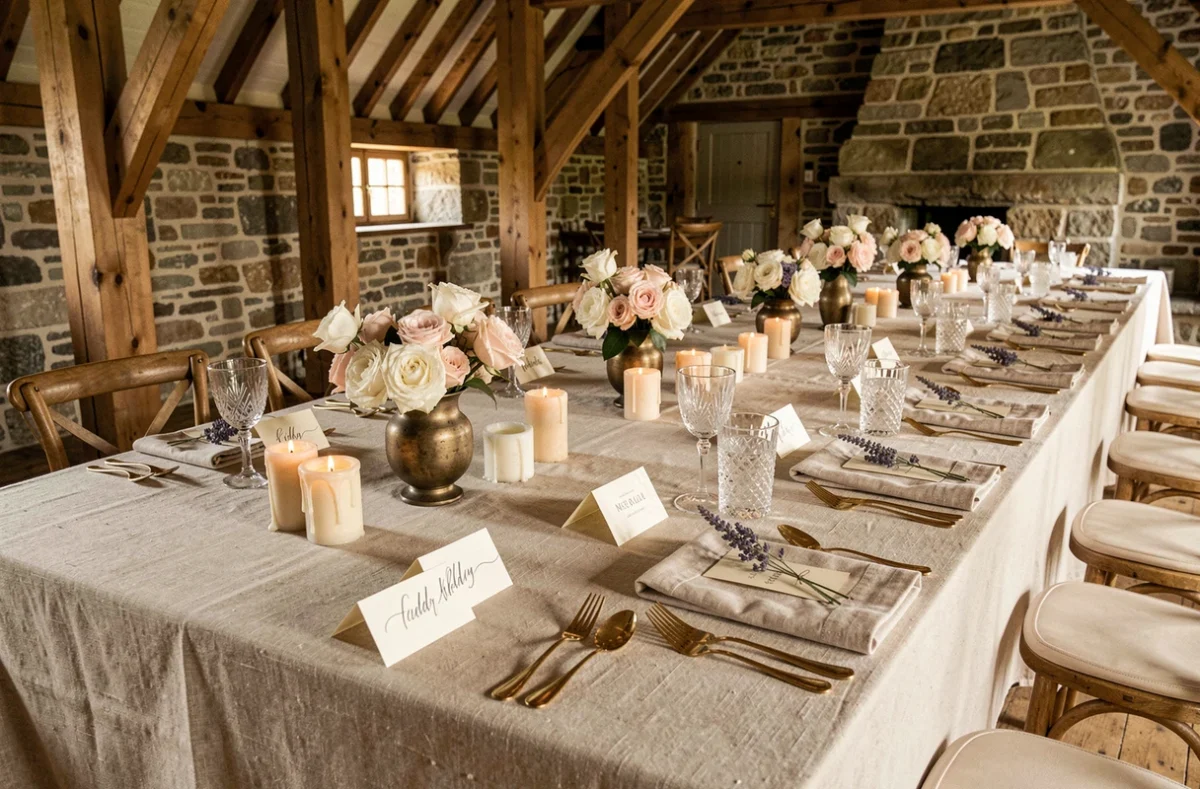
The color palettes observed this year oscillate between two poles. On one side, white and textured minimalism (linen, raw ceramics, candles). On the other, bolder combinations (terracotta and burgundy, sage green and gold) that work better outdoors and in vertical photo formats.
Lighting remains the most underutilized lever. A well-placed bistro string light transforms an ordinary garden. A sufficient number of candles creates an ambiance that chandeliers do not replicate. Lighting conditions the atmosphere more than the choice of flowers, and its cost is often marginal in comparison.
Switching to the weekend format reinforces this approach: the decoration must work both day and night, for the evening as well as for the next day’s brunch. Investing in durable elements (rechargeable candles, reusable textiles, potted plants rather than cut bouquets) reduces waste and setup time between the two days.