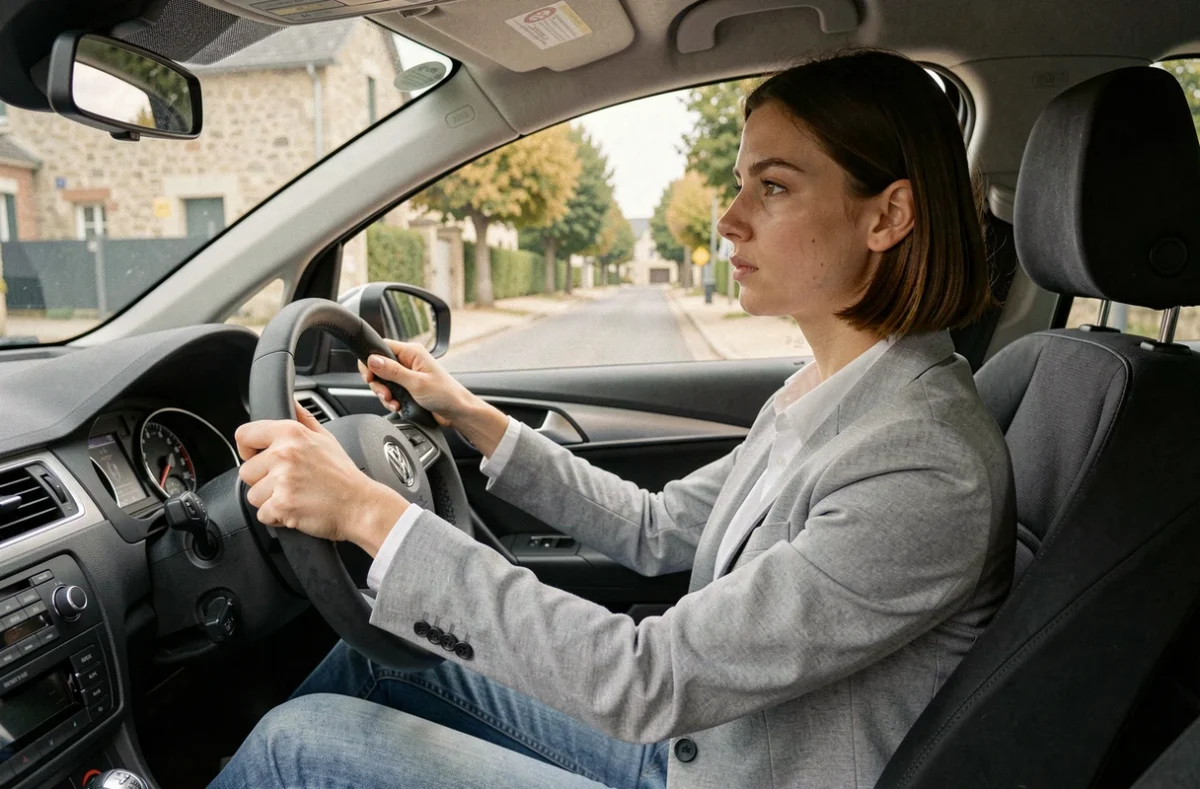
A candidate who enrolls today in a driving school will not take their driving test under the same conditions as two years ago. With restricted CPF funding, the scheduled end of the lifetime driving license, and stricter traffic sanctions, the rules for obtaining a driving license in 2026 affect both those preparing for the exam and experienced drivers. Here’s what is changing concretely, and what remains unclear.
Validity of the driving license: the European directive and its real deadlines
It is widely reported that the lifetime license is over. The reality is more nuanced. The European directive voted by the European Parliament on October 21, 2025, indeed caps the validity of car and motorcycle licenses at 15 years.
France has a three-year period to transpose this text into national law, followed by an additional year to make it applicable. In other words, no French category B license needs to be renewed every 15 years at this stage. Motorists holding a pink license or a credit card-sized license retain their rights as they are.
What is already established is the principle: licenses will eventually need to be renewed administratively. No retaking of the theory test or the driving exam, unless France decides to go further than the directive during the transposition. On this point, you can find the updates on Ma Future Voiture that detail the planned timeline.
The directive also stipulates that decisions to revoke or suspend licenses will be communicated to the country that issued the license. A French driver sanctioned in Spain or Germany will therefore see the measure applied directly to their French license, which was not systematic until now.

CPF funding for the license in 2026: out-of-pocket expenses and end of apprentice aid
Since February 20, 2026, the Personal Training Account imposes a fixed out-of-pocket expense of 150 euros to finance a driving license. This contribution applies to licenses in categories A1, A2, B1, B, and BE.
In practical terms, a candidate using their CPF to obtain a category B license will have to pay at least 150 euros out of pocket, regardless of the amount available in their account. Job seekers remain exempt from this out-of-pocket expense.
The other significant change concerns apprentices. The 500-euro aid intended for young people in apprenticeship contracts was abolished in 2026. For an 18-year-old apprentice who does not yet have a significant CPF balance, financing the license now relies on their savings or family support.
What this means for a candidate’s budget
- A salaried candidate with a sufficient CPF balance now pays a minimum of 150 euros, compared to zero euros previously in some cases
- An apprentice loses the flat-rate aid of 500 euros and must rely solely on their CPF (often underfunded) or other sources
- A job seeker registered with France Travail retains the option to use their CPF without out-of-pocket expenses, under certain conditions
Stricter traffic sanctions: major speeding and narcotics
Drivers already holding a license are affected by a notable tightening of sanctions. Major speeding, defined as exceeding the speed limit by more than 50 km/h, is now classified as a felony. This means a court appearance, with potentially heavier penalties than a simple fine.
Regarding narcotics, the rule goes further than driving under the influence. The license can be suspended even without a driving situation. A positive drug test, under certain circumstances, can lead to an administrative suspension of the license.
Urban rodeos and phone use while driving
Sanctions against urban rodeos have been strengthened. The penalties incurred are harsher, with expanded possibilities for vehicle confiscation.
For phone use while driving, license suspension is part of the applicable measures. New generation radars, equipped with image analysis systems, can detect the use of a handheld phone inside the vehicle. These devices also detect the non-wearing of seat belts.

Medical examination and international license: two points to watch
The European directive opens the door to medical examinations related to license renewal. In France, drivers subject to a medical fitness assessment (for health reasons or after certain infractions) must already go through approved doctors or a departmental medical commission.
Feedback on this point varies: the directive allows member states some leeway regarding the extent of medical checks. France has not yet specified whether a medical examination will be required at each renewal for all drivers or only for certain categories, such as seniors or holders of heavy vehicle licenses.
Regarding the international license, it will become chargeable in 2026. The applicant must also prove their normal residence in France, generally for at least 185 days per calendar year. Foreign students may be eligible provided they have been studying in France for at least six months.
The reforms of the driving license in 2026 change the rules on two distinct fronts: the cost and access to the license for candidates, and the severity of sanctions for drivers on the road. The transposition of the European directive remains the most structuring project, and its precise contours in French law have not yet been finalized.