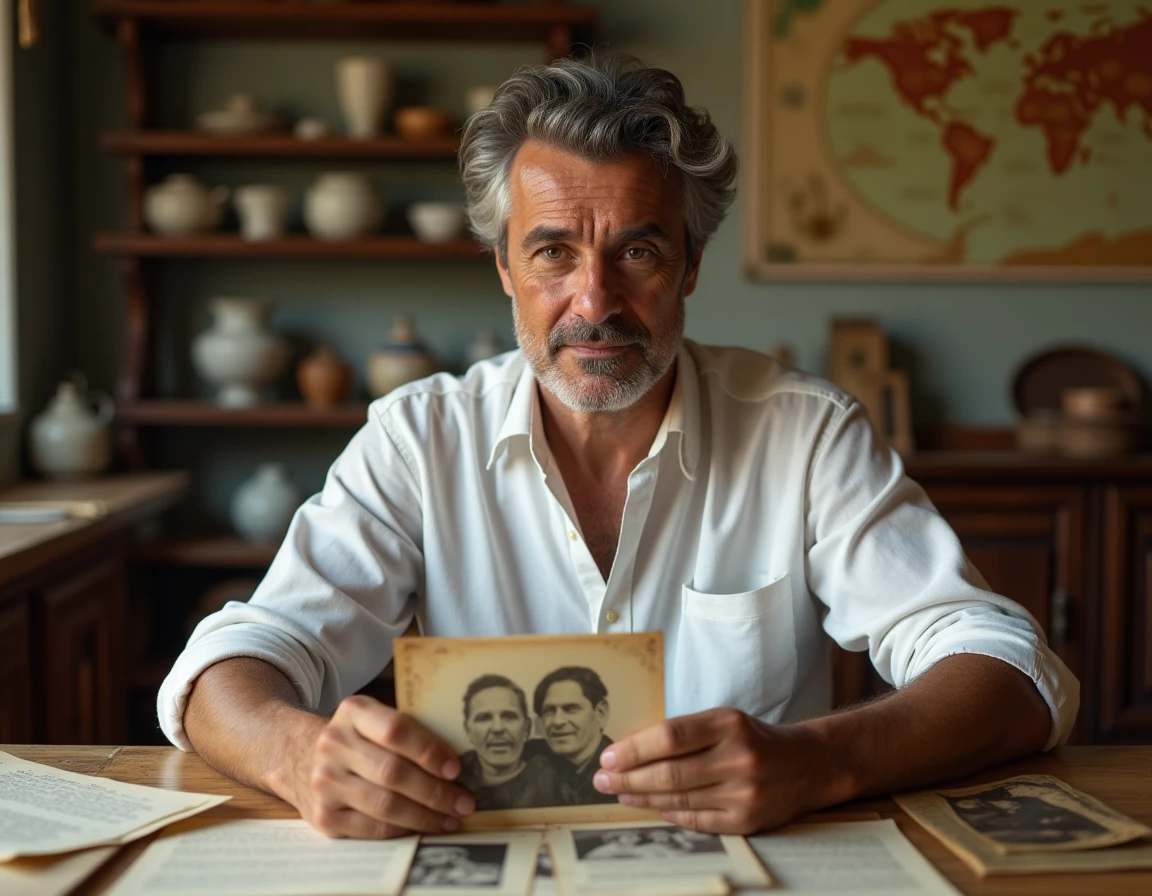
Personal identity is not built in a vacuum. It takes root in a family environment, transmitted values, and educational choices made long before the individual becomes aware of them. For Matthieu Hocque, the question of parental origin frequently arises in online discussions, often reduced to a superficial biographical quest. However, the subject deserves a more rigorous treatment, focused on the concrete mechanisms by which a family legacy shapes a trajectory.
Minimization of personal data and limits of the origin narrative

In recent years, several French media outlets and think tanks have adopted internal charters regulating the mention of the private lives of researchers and analysts. These charters are based on the principle of minimizing personal data derived from the GDPR and the Journalistic Code of Ethics. In practice, this means that information about a public speaker’s parents and childhood is only shared if it directly interests understanding their work.
This evolution has a direct consequence on the media treatment of profiles like that of Matthieu Hocque. The available public documents are limited to his professional interventions and analyses, particularly on the radicalization of youth. The veil over his family background is not an accident: it reflects an institutional desire to separate the person from their work.
Understanding the origin of Matthieu Hocque’s parents thus requires accepting that the available information remains partial, not by default, but by design.
Family legacy and identity construction: what social science research documents

There is a strong temptation to link an analyst’s positions to their “roots.” However, several recent studies published in social science journals go against this reading. The social and national origin of parents is no longer considered a central explanatory factor in the analyses produced by a researcher. The focus shifts to the methodologies employed and the research fields explored.
This does not mean that the family framework is without effect. Social sciences distinguish two types of parental transmission that structure a professional and intellectual identity:
- The transmission of educational values (autonomy, intellectual rigor, curiosity), which guides training and career choices without mechanically determining them.
- Exposure to geographical or cultural diversity within the household, which broadens the spectrum of references mobilized in analytical work.
- The family relationship to discretion and the private sphere, which conditions how an individual subsequently manages their own public visibility.
For Matthieu Hocque, the maintained discretion around his family life is itself an indicator. It reflects a constructed relationship at the boundary between the public sphere and the private sphere, a positioning that is not random but stems from an educational legacy.
Methodology and fieldwork rather than biographical narrative
In the field of radicalization, researchers and consultants are increasingly evaluated based on their field methods, not their family tree. Online content that directly links an expert’s analyses to their family origins reproduces a bias that academic research has widely documented and criticized.
This bias reduces complex thought to simplistic determinism. It prevents understanding what makes an intellectual journey unique: the methodological choices, the fields explored, the collaborations established.
Culture of biographical decoding: a trend questioned in France
The media treatment of Matthieu Hocque is part of a broader trend that several recent opinion pieces and analyses describe as a “culture of biographical decoding.” This trend involves applying a reading grid centered on the origins of young French intellectuals rather than their ideas.
The risk is twofold. On one hand, reducing a journey to an “origin narrative” impoverishes public debate. On the other hand, this approach fuels a voyeuristic curiosity that produces no real understanding of the individual’s work.
Protection strategies adopted by young researchers
Feedback collected from groups of young researchers and public policy consultants indicates an increase in online privacy protection strategies. These strategies are not based on paranoia. They respond to a pragmatic observation: any personal information published can be decontextualized and instrumentalized.
Matthieu Hocque, by maintaining a strict separation between his public interventions and his family life, applies a logic that many analysts of his generation share. This choice is not an obstacle to understanding his work. It is a condition for it.
Personal identity of Matthieu Hocque: what is at stake beyond parental origins
Identity is not limited to lineage. It is built through an accumulation of experiences, training, and intellectual confrontations. For Matthieu Hocque, the documented professional journey (consulting, analysis of institutional systems, expertise on radicalization) outlines a trajectory where each step adds a layer of competence and perspective.
The family framework likely provided the foundation. The transmitted values, intellectual discipline, and relationship to the outside world constitute the bedrock. But professional identity is forged in action, not in heritage.
Seeking to document the origin of parents at all costs to explain a journey amounts to confusing the map with the territory. The territory, here, consists of Matthieu Hocque’s work, analyses, and public commitments. The family map, however, remains deliberately incomplete, and it is precisely this that allows the territory to speak for itself.