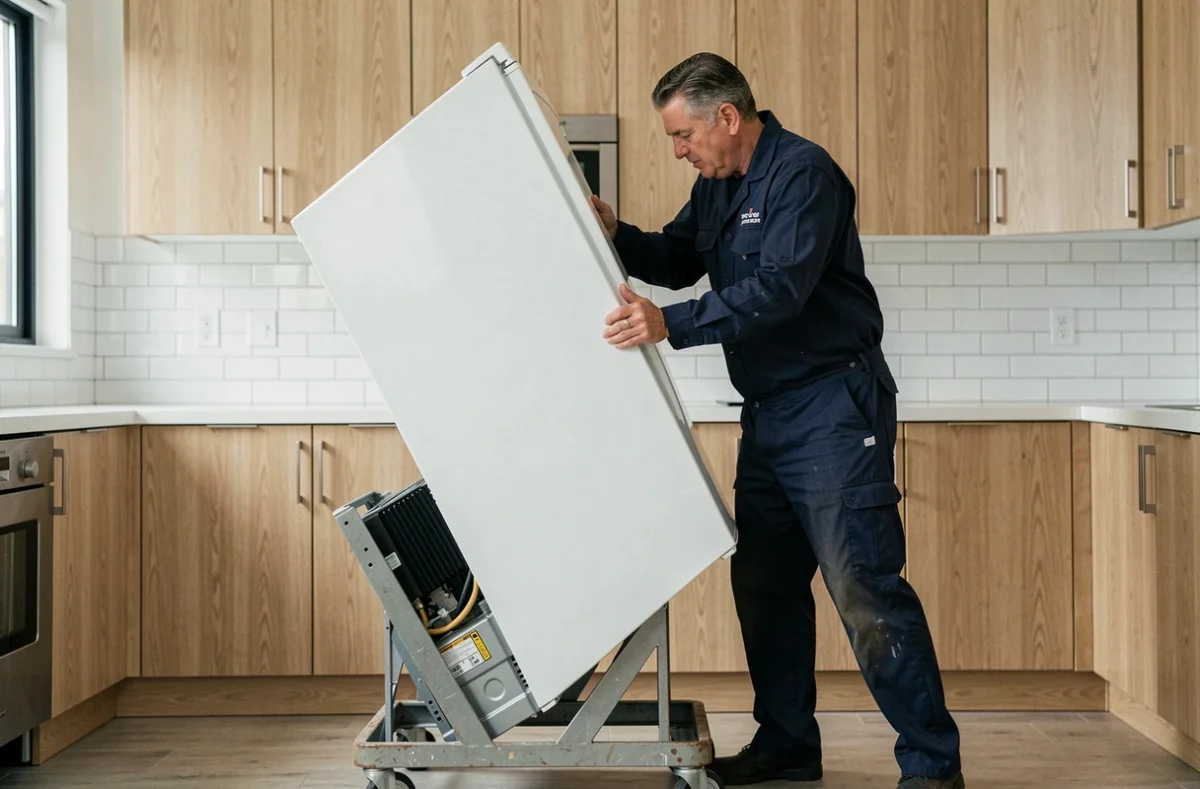
Transporting a refrigerator on its side remains a common practice during a move, due to lack of space in the vehicle. The question of the waiting period before reconnecting consistently arises, and the answers vary according to sources: some suggest a few hours, while others recommend a full day. This disparity can be explained by technical parameters that classic guides rarely mention, particularly the influence of outside temperature on the necessary resting time.
Compressor Oil and Refrigeration Circuit: What Really Happens When a Fridge is Laid Down
The compressor of a refrigerator operates thanks to a lubricating oil that remains, in a vertical position, confined within the crankcase. When the appliance is laid down, this oil migrates into the refrigeration circuit and mixes with the refrigerant fluid.
The problem is not the laying down itself, but the premature reconnection. If the compressor starts while the oil has not returned to the crankcase, it runs dry. The internal mechanical parts experience abnormal friction, which can lead to accelerated wear or a complete blockage.
The duration for which the fridge has been laid down is not the only factor. The relevant question concerns how long to wait before reconnecting a laid-down fridge, and the answer also depends on the exact tilt during transport and the type of compressor installed.
Rest Period for the Refrigerator According to Transport Position
Manufacturers like Samsung, LG, or Whirlpool remind in their recent manuals that transport must remain strictly vertical. Laying it down should only be considered as a last resort.
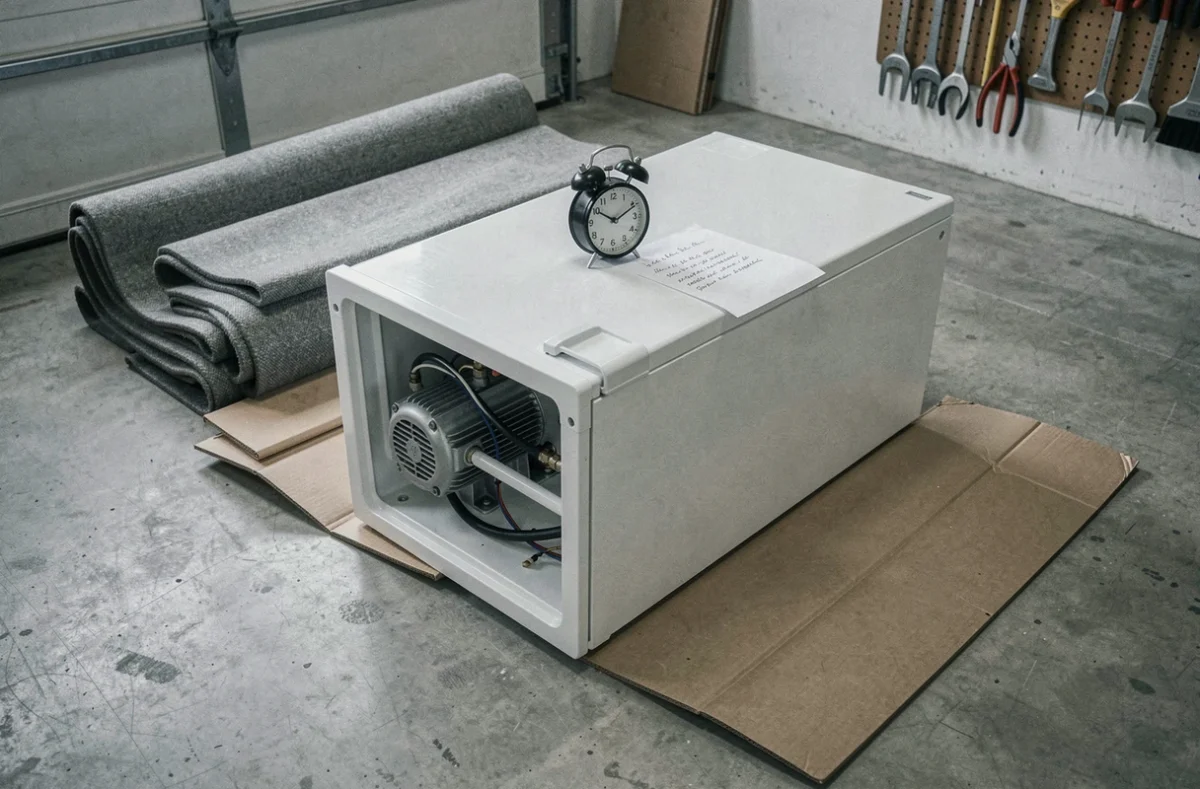
When the fridge has traveled upright with a limited tilt (less than 45 degrees), a resting period of a few hours is generally sufficient. In contrast, an appliance transported flat requires a significantly longer resting time before reconnecting.
- Vertical or slightly inclined transport: a resting period of two to six hours is the range usually recommended by manufacturers.
- Short-term laid-down transport: allow at least twelve hours in an upright position before reconnecting.
- Prolonged laid-down transport or older appliance: a waiting period of twenty-four hours remains the safest recommendation, as older compressors tolerate oil migration less well.
These ranges are guidelines. The manufacturer’s manual always takes precedence, as the design of the refrigeration unit and the type of refrigerant fluid vary from model to model.
Ambient Temperature and Reconnection Delay: The Ignored Parameter
A factor rarely mentioned in moving guides concerns the outside temperature at the time of transport and resting. In hot weather, the compressor oil is more fluid and disperses more in the refrigeration circuit. It therefore takes longer to return to the crankcase once the appliance is upright again.
Technical recommendations published in 2024-2026 suggest extending the resting period in case of laid-down transport in hot weather, increasing from a usual range of four to six hours to twelve or even twenty-four hours. A move in the middle of summer thus requires increased vigilance compared to winter transport.
Conversely, transport in cool weather with a very brief laying down (a few minutes to pass through a narrow door, for example) poses limited risk. A resting period of a few hours is usually sufficient in most cases.
Common Mistakes After Transporting a Laid-Down Fridge
The first mistake, the most common, is to reconnect the appliance immediately for fear of losing perishable goods. A compressor that starts without sufficient oil can fail permanently, which costs much more than a few hours without refrigeration.

Another trap: filling the refrigerator immediately upon reconnection. The appliance needs several hours to reach its set temperature. Loading a still-warm fridge with fresh food slows down the temperature drop and excessively strains the compressor.
- Not checking the manufacturer’s manual for the exact recommended waiting period for the specific model.
- Laying the fridge down on the side where the compressor is located, which worsens oil migration in the circuit.
- Forgetting to remove internal transport wedges or protections before reconnecting.
- Neglecting to clean the condenser (rear grille) before putting it back into service, especially after a dusty move.
Commercial Fridge vs. Domestic Fridge: Different Requirements for Reconnection
General public content treats the subject uniformly, as if all refrigerators follow the same rules. Field feedback diverges on this point. Professional refrigeration units (restaurants, laboratories) use more powerful compressors and more complex circuits.
Some manufacturers of professional equipment require a technical check before re-energizing after being laid down. A technician must check the oil level and the integrity of the circuit before any restart. Connecting a professional fridge without this check can void the manufacturer’s warranty.
For a standard domestic refrigerator, this check is not required. Adhering to the vertical resting period is sufficient in the vast majority of cases. The available data does not allow for defining a universal threshold applicable to all models, hence the importance of consulting the specific documentation for each appliance.
Home Insurance and Breakdown After Moving: What is Covered
A refrigerator breakdown occurring after a move raises the question of coverage by home insurance. Recent clarifications from insurers indicate that the simple breakdown related to improper reconnection is generally not covered. Home insurance covers events like electrical surges or water damage, not a handling error.
The loss of food due to a breakdown can, however, be compensated under certain contracts, provided that the breakdown results from a covered event (prolonged power outage, for example). Checking the clauses of one’s contract before moving avoids unpleasant surprises.
The resting period after laid-down transport is not just a theoretical precaution. It is a technical step that protects the compressor, preserves the lifespan of the appliance, and conditions the maintenance of the manufacturer’s warranty. Each model has its specifics, so the manual remains the most reliable reference document.